An Interview with Mark Shayler
Our chat with the environmental consultant, author and public speaker
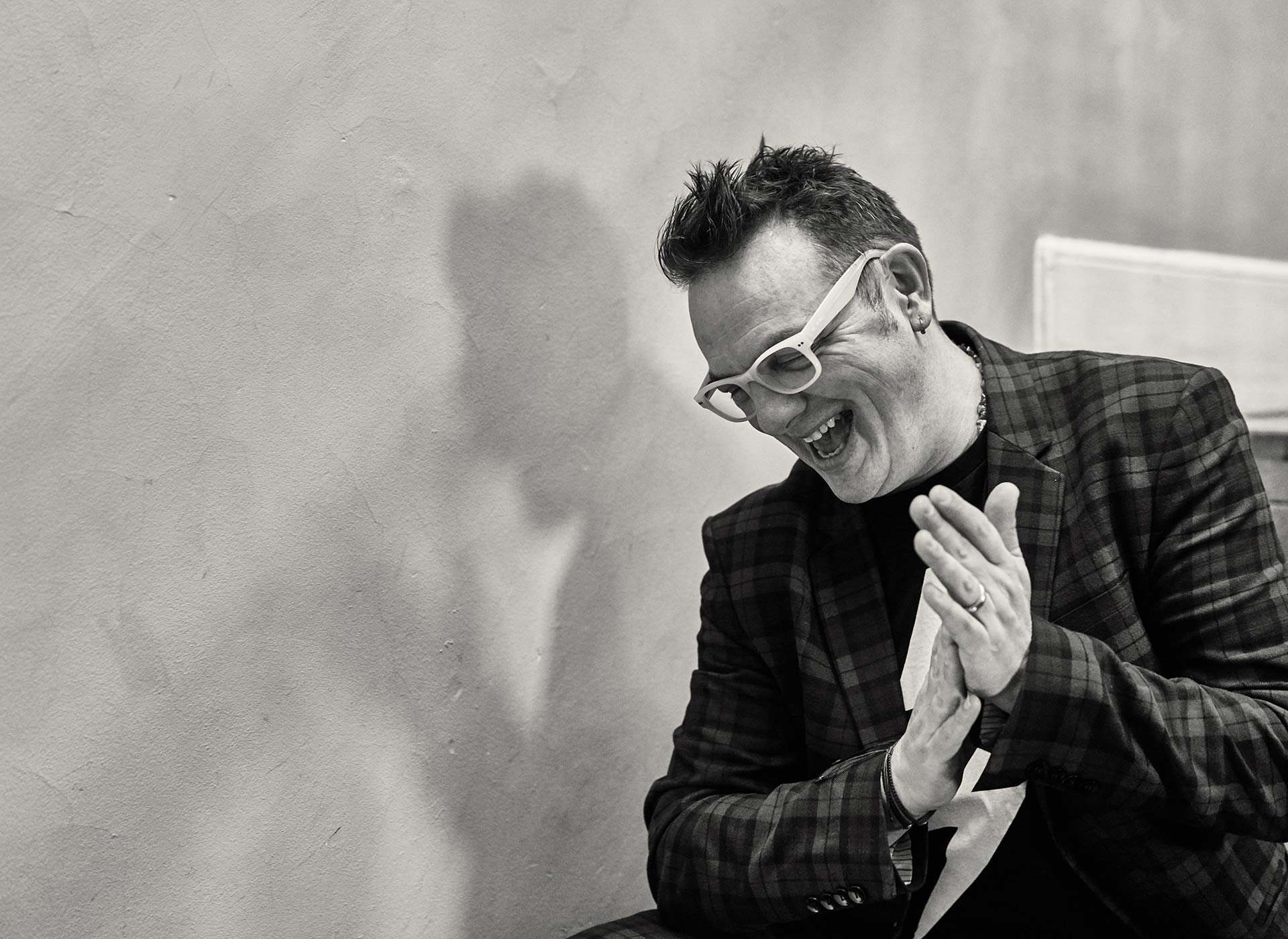
Operating from a studio at the bottom of his garden, Mark Shayler works with big companies to do the stuff that big companies can’t do—thinking way beyond the Powerpoint presentation and asking the questions those with a company car would be too scared to ask.
Working in the worlds of sustainability and innovation, he’s helped huge, omnipresent brands like Coca-Cola, Nike, Asda and Subway steer their sizeable ships towards a better future.
He also co-founder of Reasons to be Cheerful, teaches Qi Gong and likes going for long walks everyday with his wife.
This is an interview with him on the subjects of work, smashed IKEA pottery, swimming and our addiction to buying stuff…
You do a lot of different things—whether it’s consulting for big companies or running a creative agency, as well as public speaking and probably a few other things. How do you juggle all that? How do you find the balance?
That’s a really good question. Essentially, the core of the business is the sustainability consultancy—and within that comes environmental workshops. But then we also add into that innovation, brand articulation, and helping companies find out what they’re for. And then there’s the coaching and one-to-one work, which is in many ways the most rewarding. I’m also a keynote speaker and author.. We also run a series of events called Reasons to Be Cheerful, which my daughter and wife lead on. This is all ace but at my heart I’m a scientist who wants to solve human problems artistically, so we also need to understand impact, that’s why we deliver scopes 1-3 carbon footprinting.
You work with some big companies. As someone in a shed at the end of the garden, I imagine that’s kind of a contrast from how these companies work. How do you fit in there? Or are you almost hired because you don’t fit in, if you get what I mean?
Fundamentally, what you’re asking is, how do I get people to trust me when I’m a bloke in a very big shed at the bottom of his garden?
Haha—pretty much yeah…
And these are massive companies. But you nailed it with your second comment—they need the antidote to what they are—they can’t have the same thinking. If I’ve got the overheads of a creative agency in Clerkenwell, I’m going to be twice the price and deliver probably half the value. It’s a really interesting dilemma I think. How do you stay small and funky, and still attract big businesses? Normally you do that by finding someone who wishes they were in a small and funky business, inside the big business, and they trust me.
Yeah, that makes sense. They need someone who isn’t them. Once you are working with them, how do you make sure your work doesn’t get watered down?
That has happened. I’ve worked with some really brilliant, big, amazing companies, who have asked me to do some really big, brave, brilliant work… and then not done anything with it. Some of my best work is for a company that not everybody will love—but the work I’ve done for them is to shift them massively from where they are, to where they could be… but it’s still a ‘could’—and they’ve not pressed the button on it.
I find that heartbreaking, but I can only go so far—I can change the minds of the people I’m with, but I can’t change the corporate strategy at a higher level.
Subscribe to our newsletter
Some of these companies are making so much money, they must think, “Well, why would we change how we do things?” But what are the easy things that they could be doing, that they miss?
That’s a good question. In terms of sustainability it comes in phases really. Phase one—get the basics right. That means the really simple things—look after your carbon, look after your environmental impact. Don’t focus on the totems of good—those things that are important, but tiny—focus on the big impacts, and to do that, you have to know what your impact is.
And then you go back into your supply chain—you as a business are responsible for the impact of your suppliers, so you need to understand what that is. Having those conversations around better supply chains are really important.
And only then, would I begin to talk to my customers—saying, “This is what we’re doing, this is how we’re doing it.” Customers often focus on the things that have the smallest impact, but are the most visible—they’ll be focussed on plastic and packaging—but in reality that’s usually a really tiny impact in terms of the environmental impact of the business. I wouldn’t even have that conversation with them until I’ve got the big things sorted.
Once you’ve started to do what you do less badly, you can begin to move towards becoming a regenerative business and moving towards social and environmental equity. Rather than reducing the harm you do, actually making sure everything you do has a positive impact, not just when it comes to sustainability, but also the impact on people. I think we often forget that.
“I can ask really tricky questions and become the little pea underneath all the mattresses that the princess is laying on.”
Even companies perceived as being in a damaging sector—fast fashion or fast food—they can do so much. And they’re operating at scale—so I love working with them, because if I want to make the biggest difference, going to work with a really niche producer of hand-rolled teas isn’t going to change the world—but going to work with a massive tea producer is. I do work with smaller companies that are moving fast, but I prefer to work with big, often slow companies who are so far from where they need to be, that you can nudge them and make a much bigger impact.
Yeah—I suppose if a brand is getting so much wrong, you can tweak things and make a big difference.
A good example of this was when I worked with Belkin—the computer consumables company. They got me in to look at their packaging… and it was mad. We reduced the average pack size by 70%—and that was a really interesting piece of work that meant huge financial and environmental savings—it’s a case study, so I can talk about it—that was around £3 million a year saved on the products we looked at.
But that wasn’t the main benefit… the main benefit was that when your USB dongle is in a massive box, you can only get so many boxes on the shelf… so by lunch-time the retailer has sold out and they need another delivery. And when the boxes are that big, they’re only really half filling the wagon, and then you’re only half filling your warehouse.
The knock-on effect is huge.
It’s massive. Their mentality was that big boxes meant more retail landscape—the surface area visible on the shelf—so you see it. But you don’t buy like that. No one wants to buy a USB dongle because it’s bigger. And that’s a really good example.
Is a lot of this just common sense?
Yeah. But back then, fifteen years ago, I had to fight my way through in order to get that heard. Sometimes I do think I’m selling common sense. Another really good example of this was when I worked with Ikea at their depot in Peterborough. They wanted to increase the packaging in transit for some Romanian pottery they were bringing in. They were lovely pots—but every time they came in, the bottom row of pots on the pallet was broken.
They thought it was the weight or the packaging, but I’m old fashioned—so I said, “Show me where the lorries come in.” We went to the entrance of the business park—I watched the lorry come in and the very first thing it came across was this speed hump. So when the next one came in I stopped it, checked the bottom layer of the pottery, then when it drove over the speed hump, I checked it again and it was all broken. So you just think, “Let’s take the speed hump out.” And that’s a brave thing to do, because speed humps are good, right? But they’re not always good.
So sometimes it really is just common sense. I just stand there as an outsider, saying, “That doesn’t make any sense.” And sometimes it’s really, really technical like maximising pack fill speeds whilst reducing film gauge—and that’s really exciting for me too, but in a completely different way.

A lot of people have that thing of “What can I do, I’m just one person?” But you don’t seem to have that.
It’s really interesting—I think the opposite. I think, “What can’t I do, I’m just one person?” I can ask really tricky questions and become the little pea underneath all the mattresses that the princess is laying on. I love those opportunities that are created by constraint or difficulty or challenge. I love the fact that some companies have business models that mean that if they shift, they’ll lose so much money, but if they don’t, they’ll ultimately collapse. I love those really tight spaces. I like the fact I can be a pea sometimes.
I also really get a buzz from unleashing talent inside an organisation—maybe one that’s forgotten it’s got amazing people, one that recruits into roles rather than looking at all the talent it’s bringing in. I absolutely love making sure that businesses can see the potential of the people they employ, and the people can see the potential of the businesses they’re in as well. I’m a bit disruptive really, and I always have been.
If you’re into Chinese astrology, I was born in 1968—the year of the Monkey. The monkey is the most disruptive and irreverent of the Chinese star signs—and in particular the ’68 batch—we were fierce. That’s why my business is called Ape, and it’s why Gorillaz are called Gorillaz—because Hewlett and Albarn were both 1968 monkeys. And if you speak to any teacher from the 80s, they’ll say, “Yeah, I really loved teaching… apart from that year, they were a nightmare.” We were famously difficult, and I like that. The other reason the business is called Ape is because it’s that blend of nature and nurture—there’s a little aggression, but it’s also caring.
Does this disruptiveness mean you come up against a bit of friction or pushback? Your role is to kind of be the fly in the ointment.
Yeah—it’s a real challenge. I’ve got ADHD, which I was really surprised about when I got diagnosed a couple of years ago, but no one else was. And with ADHD comes something called rejection sensitivity dysphoria, which is where you get quite wounded when people reject you—you take it personally. And I’ve had that—and I end up not just taking it personally, but rushing to understand it, and looking at my own flaws.
So those two things combined—having that rejection sensitivity dysphoria but also doing brave work and trying to push water uphill sometimes, is a recipe for disaster if I’m honest, because obviously I’m putting myself in the place where I will be rejected more often. So I’ve had to have a proper word with myself about that stuff, and I’ve got a lot thicker skin now than I used to have, but it’s hard.
How do you see things changing? As someone who works with big companies to make a better future, how do you see things in the next ten years?
I always respond to this by saying that I’ve never been more fearful, but I’ve also never been more hopeful—and I can hold both of those thoughts in my mind at the same time. We live in an incredibly polarised world, and it frightens me—not because it’s going the wrong way—but trying to establish what the truth is from here on in, will be nearly impossible. We view everything (including truth) through a lens of belief systems. My disaster tendencies are all around social and political structure, belief systems and poor leaders—that’s what I fear more than anything. We can solve climate change, we’ve got the creative bravery to do that, but what we can’t stop is gullibility.
We have a choice—we get up in the morning, we go out and we make ourselves available to information that is neutral or independent, but we choose not to. We go out looking for outrage or the things that make us feel better about, that reinforce our views. And that’s got to such a high point, that I don’t know how we can get back from there.
What do you do to try and temper these disaster tendencies?
There are a few things you have to do. You need to read what the other side are writing. I can’t stand here and criticise people who are in their little mirrored room, if I’m just living in my little mirrored room—so you have to spend time looking at both sides.
And then in terms of protecting your mental health, you need to do maybe four things. Firstly, spend time with people who aren’t like you—who’ve got different views and are challenging in nice ways. Number two; you need to find those people who are open and growing, rather than closed and shrinking in terms of their philosophy and mindset. Number three; moving more has never hurt anyone—no one has ever got ill from moving more. When you start dying, it’s because you stop moving.
I love swimming—and I didn’t know this until five years ago. I was a messy swimmer—I’d describe myself as swimming like a boxer—so I went for swimming lessons and the coach was amazing. He said, “Do you want to stop swimming like a boxer? Stop fighting the water, slow down to speed up.” And you’re a smart guy—so you can see the analogy there.
Haha… I was going to say if that fits with your work. Your job is to be like the swimming teacher, spotting what creates too much wake and not enough speed.
Totally. It’s exactly that. And I don’t know how I know sometimes—you just see it. It’s the same with people. You can just see when someone is talking, you can see a physical or psychological tick or block that belies a kind of limited self belief which is keeping them small.
Cold water swimming for me in particular has been a game changer. I don’t want to sound like a 56 year old male cliche, but I am. I love that. I love riding my bike. I love walking. I’ve also recently got back into strength training. I played rugby a lot when I was younger. This was back in the 80s when rugby was a contact sport, not a collision sport. There’s something here that I think is really important in life generally—the aim of the game was to run into space, now the aim appears to be to run into contact and conflict. And I think that’s often how businesses are run.
But yeah, I like the physical element of rugby, so I’ve reintroduced a bit of boxing and crossfit back into my routine, and I love it—it’s been massive for me.
And then the fourth thing, on the slow side, you’ve got to protect your peace. So I meditate and I teach qigong—the slow stand-up movement which Tai-Chi is an offspring of. And all of those things really help, but sometimes I wake up and there’s fear and there’s challenge in my mind, and no matter how many breathwork classes I do or how many times I jump in the cold water, it’s still there. So there has to be a practical application—and that’s the way that I work—to imagine a world that hasn’t arrived yet.
I get what you mean. It’s easy to be some pious monk—living the pure life, but maybe it’s not that helpful to anyone but yourself? Like being a self-sufficient farmer—yeah it’s kind of cool, but why not share the turnips?
You can be chill as fuck—zenned out and meditating, whilst ignoring the fact that consumption is un-paralleled and there are no constraints on economic growth and a growing poverty gap, whilst politicians have literally siphoned the money from the public and pushed it into private businesses… but you’re zen. You’ve been on your retreat to Bali and you’re zoned out. But that’s not enough.
Definitely. Do we all need a purpose?
Absolutely. I think we need to align with something bigger than us, bigger than profit, to feel complete.
And I suppose that comes to your work… trying to help these companies find a purpose and a reason to exist.
Yeah—and there’s nothing wrong with making money. I’m not one of these de-growth purists that feels profit is bad, there is a limit to growth most definitely, and we’re way beyond it. However, the challenge we face is how do we make more money from selling less stuff? It’s not profit that’s the problem, it’s the single sole focus on profit with no constraints, that has caused the problem. So I love that challenge of how do you become more profitable whilst becoming more equitable and less environmentally impactful. That’s a brilliant challenge, and that’s what we’ve got to do.
What do we sell instead?
This is a really rich area to have a conversation in. The first thing—what are you buying when you go shopping for clothes? I can’t remember the exact facts… but we have on average around nine items in our wardrobes we’ve never worn, and we buy two and a half pairs of jeans every year, even though we own seven pairs already. So we’re not buying leg coverings, we’re buying some form of happiness when shopping. Shopping has become an antidepressant.
But it’s not much to shift this and say that you don’t need new stuff to do that, and you don’t even need second hand stuff to do that—you need better stuff to do that. The options in the fashion world are firstly make better so it’ll last longer and change the business model so not only the wealthy can afford a £240 pair of hand-made jeans, or number two; those fast-fashion houses, they are so deeply embedded in this world, and their whole ethos is circularity of polymer and chemical recycling.
“I think we need to align with something bigger than us, bigger than profit, to feel complete.”
So a polyester jumper that you buy for £5 from them as part of a monthly rental scheme, and after a month, that goes back. And if someone else wants that as a jumper then that’s amazing, but if they don’t, it gets re-processed back down to polymer and comes back to life as a pair of socks. So they’re looking at it and saying that it’s not the consumption that’s the issue, but it’s the fact that the system is leaking that’s the issue.
And then there’s the repair world. So there’s two or three different approaches to fashion—and none of which mean owning less, or earning less—it just means completely changing the way we build business models, and changing the way we build models of happiness and joy. That’s the thing that’s missing. Because more doesn’t mean happier—and once we understand that then nothing is impossible.

What happens when everyone hooked on buying clothes gets a better hobby? What happens when they all get into swimming or riding bikes? Is all this buying just an addiction?
It is an addiction. When you look at masculinity the four archetypes are lover, warrior, magician and sovereign. And the lover isn’t about sex, it’s about addiction—whether that’s food or drugs or power or whatever. So that’s a really interesting archetype within the male psyche. We’re not necessarily consuming because it’s cool, we’re consuming because we get a dopamine rush from it.
If we have the new thing we hope we will be viewed better or cooler by our colleagues, we’ll have whatever kudos we want to have. But in reality, without sounding like some born-again Buddhist, we just need to be really comfortable in loving who we are, regardless of what we own and what we consume.
Our self-worth shouldn’t come from the way that we dress or the car we drive, it should come from the way that we lift people, the way we help people and the way we stand up to the things that are wrong. And until we unpick that one, we’ve got massive challenges in terms of derailing the consumption model.